
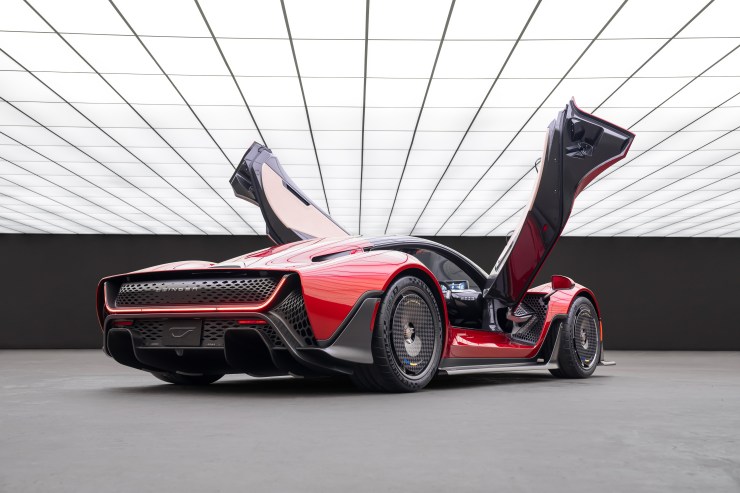
In an industrial office park south of Los Angeles, an American automaker is churning out sports cars in an attempt to transform manufacturing as we know it.
“It’s literally like saying in the typewriter era, ‘I’m about to create a desktop system,’” said Kevin Czinger, founder and CEO of Czinger Vehicles and Divergent Technologies.
Czinger’s system is making cars and car parts. They’re designed using artificial intelligence, constructed with specialized 3D printers and assembled by a team of robots.
“What I’m trying to do is create a machine that takes manufacturing, which is still stuck in 100-year-old-plus technologies, into the digital age,” Czinger told Marketplace’s Kai Ryssdal on a tour of his companies’ production facility in Torrance, California. “3D printing is one piece of an overall system.”
The Divergent Blade, which was designed by Czinger, made headlines for featuring a fully 3D-printed body and chassis when it was unveiled in 2015. Customer deliveries for Czinger’s latest offering, the 21C, are scheduled for later this year.
The 21C has a $2 million base price, and as Czinger was quick to point out, set records at both WeatherTech Raceway Laguna Seca and the Circuit of the Americas in 2021.
“What it showed is with these tools, a small American team of inventors and designers could, within a two-year period of time, create a car that outperforms every existing car company’s vehicle,” he said.
But the 21C is only one step in Czinger’s ambitious plan to digitize manufacturing.
“If you wanted to leap ahead 20 years, you know what you want to have?” he asked Ryssdal rhetorically. “You want to have a globe filled with localized manufacturing where there’s no barrier to entry to people that want to create useful products.”
The term “localized manufacturing” is a key component of Czinger’s thesis. While colossal factories like the Ford Motor Co.’s River Rouge complex in Michigan or Foxconn’s compound in China known as “iPhone City” rely on economies of scale to cover their startup costs, Czinger argues that flexible manufacturing facilities that can adapt to changing demand and design specifications are the way of the future.
“You don’t have to have hundreds of printing presses printing different books,” said Czinger, returning to his desktop computer system analogy. “You can send data and it prints the Bible, you send data and it prints the ‘Brothers Karamazov’ … that’s the fundamental difference.”
That flexibility, he said, can help localized factories remain permanent fixtures of their communities.
As an example, he showed Ryssdal a hexagonal-shaped assembly system at the center of the production facility.
“This has assembled a sports car, luxury SUV parts, other brands’ sports car and a drone for General Atomics back-to-back-to-back with zero switchover time,” he said. “And if you changed all of those designs and rolled them back in, it would immediately start to assemble them again.”

“Let me ask you the labor force question,” said Ryssdal, mentioning Czinger’s older brothers, who worked as car dealership mechanics in Cleaveland while he was coming of age. “Could they get a job here working for their little brother?”
“Absolutely,” Czinger responded. “When people asked me the question, ‘Will this wipe out auto factory jobs?’ which is the question you’re really asking, [I say,] ‘If you go to a modern auto factory, you see half-mile-long lines where … there are no workers.’” At today’s factories, robots doing specialized tasks, like welding one piece of sheet metal to another, have already taken the place of many workers.
Czinger insists that the majority of jobs that do still exist in modern auto factories — general assembly jobs — would not be impacted by the type of transformation he envisions.
“We replace the cost and expense of building those leviathan factories, with all of their capital risk … with something that’s much more flexible,” he said. “So it actually makes any automotive factory in the West stronger and more competitive, without taking away any general assembly jobs.”
This system is still relatively new. Czinger’s companies are in the midst of building 80 Czinger 21Cs, while making parts for other brands such as Aston Martin and continuing to refine their technology.
As they ramp up production, Czinger said financing remains one of his biggest headaches. “Our financial system and venture capital are designed to finance quick cash-generation software applications,” he said. “I’m doing something that literally required hundreds of fundamental inventions just to make it work.”
As the credit markets tighten in the wider economy, Czinger said he’s grateful for a recent investment from Hexagon AB, a Swedish company.
“That gives us a very good-feeling capital buffer, knock on wood, some years out,” he said.
There’s a lot happening in the world. Through it all, Marketplace is here for you.
You rely on Marketplace to break down the world’s events and tell you how it affects you in a fact-based, approachable way. We rely on your financial support to keep making that possible.
Your donation today powers the independent journalism that you rely on. For just $5/month, you can help sustain Marketplace so we can keep reporting on the things that matter to you.


